Guides
Lunar New Year flowers: plants, bouquets and delivery
Lunar New Year 2027 falls on Saturday 6 February, and in Korea Seollal is on Sunday 7. As a gift I would choose a plant that outlasts the celebration: a three-stalk lucky bamboo or a Phalaenopsis orchid. If you are going to the New Year’s Eve dinner on Friday 5, a bouquet in red and gold tones is a good alternative.
2027 dates: Chinese New Year, Seollal and Tết
In the Chinese calendar, Lunar New Year 2027 falls on Saturday 6 February and begins the Year of the Goat. New Year’s Eve is Friday 5 February, the night of the family reunion dinner. Chinese New Year is celebrated over fifteen days.
In Vietnam, the first day of Tết is also Saturday 6 February. In Korea, Seollal falls on Sunday 7 February, with public holidays from Saturday 6 to Tuesday 9. These are three celebrations with their own customs, even though they share the season. The date changes every year, so do not use 6 February for other years.
Plants and flowers linked to the New Year
Families in southern China traditionally decorate the home with a flowering peach or plum tree. Thousands are sold at the annual flower fairs in Hong Kong and Guangzhou. A potted kumquat is associated with good fortune and wealth, because in Cantonese its name sounds like the words for “gold” and “luck”.
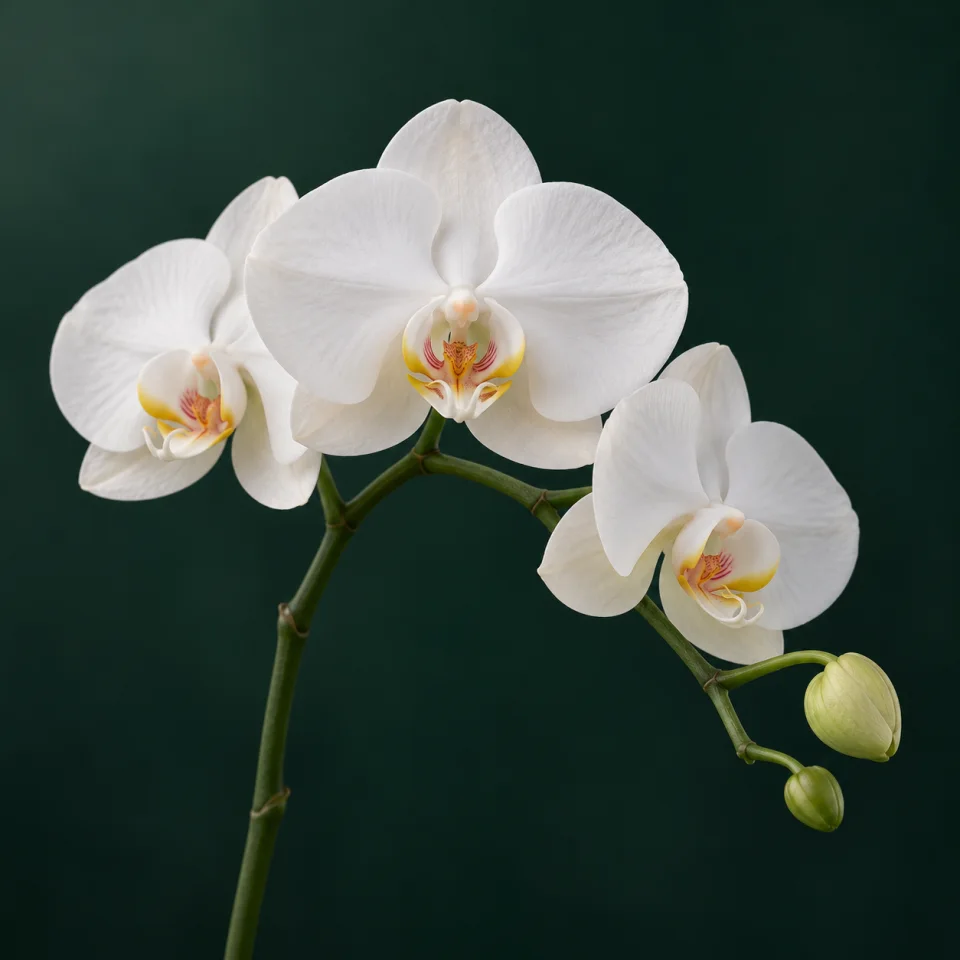
The New Year narcissus is Narcissus tazetta: white flowers with a yellow cup and a pleasant scent, grown in a shallow dish with pebbles and water. Orchids, pussy willow branches and lucky bamboo are also considered auspicious, and lucky bamboo is a common gift at this time of year.
In Vietnam, flowering peach branches (hoa đào) are the tradition in the north and yellow apricot blossom (hoa mai) in the south. Kumquat trees heavy with fruit are seen across the country, and the more fruit a tree carries, the more luck it is said to bring. These plants come from Chinese and Vietnamese customs. For a Korean family celebrating Seollal, choose according to their taste and the space they have at home.
A plant or a bouquet?
A plant stays with the household through the celebrations and beyond. Lucky bamboo needs little care and grows in water or soil. In Chinese tradition the number of stalks carries meaning and four is not considered lucky, so ask for three, five or six.
A flowering Phalaenopsis orchid suits a home with a bright spot out of strong sun. A kumquat with fruit is closely tied to Cantonese custom; choose a size that will fit in the recipient’s home.
A bouquet works better if you are going to the New Year’s Eve dinner and want something for the table or the hallway. Ask for red and gold tones: in Chinese culture red is associated with prosperity, and the gold of mandarins and kumquats with good fortune. If the florist has peach, plum or willow branches, ask for them with the buds still closed so they open at home.
Visits and delivery in 2027
If you are invited to someone’s home during the celebrations, in Chinese communities such as Singapore’s it is customary to bring the host a pair of mandarin oranges and receive another pair when you leave. The plant or bouquet can go with them.
In 2027 New Year’s Eve falls on a Friday and New Year’s Day on a Saturday. If you want the flowers to arrive for the dinner on Friday 5, book delivery for Thursday 4 or Friday morning, in a slot when someone can receive them. For a Korean household, bring it forward to Saturday 6 if the florist does not deliver on Sundays.
In February, protect the orchid from the cold on the way: it needs more than 16 °C (61 °F).
On arrival: care and pets
Place lucky bamboo in bright light out of direct sun and use filtered water or rainwater: chlorine and other tap-water additives can turn the leaf tips brown. The orchid needs a bright spot and watering that drains freely.
In a home with cats or dogs, lucky bamboo and narcissus are toxic if eaten, and the narcissus bulb is the most poisonous part. Phalaenopsis is not toxic to dogs or cats. For a kumquat or any other plant, check the exact species before leaving it within their reach; the guide to flowers and pets helps you do this.
An example order and card
You could ask: “I would like a three-stalk lucky bamboo planted in soil, in a pot, as a Lunar New Year gift. I will collect it on the morning of Friday 5 February 2027. If there are pussy willow branches, I would like to add a few, wrapped separately.” For delivery, add the address and a slot on Thursday 4 or Friday 5 when someone can receive it.
On the card you could write “Happy Lunar New Year. Wishing you good health and a year full of good moments.” If you know the greeting in the family’s language, add it underneath. Adapt the example to your relationship with them.
Which flowers to choose
Compare flowers to choose the format, colours and care that suit the occasion.
Guides to help with your decision
Should you give a bouquet or a potted plant?
Choose between a bouquet and a plant according to space and care. Compare houseplants with a rose bush for Sainte-Catherine in France on 25 November.

What to write in a card with flowers
Ideas for writing a flower card in your own words. Examples for birthdays, thanks, anniversaries and sensitive moments.

Which flowers to give to someone with cats or dogs
Flowers for a home with cats or dogs: options to consider, checking the whole bouquet and precautions with lilies, holly and mistletoe at Christmas.
How to order flowers from a distance and plan delivery
Send flowers from a distance: format, date, address and handover, including a group gift. Examples and practical advice for different countries.
How to care for a Phalaenopsis orchid indoors
Light, watering and roots: care for a Phalaenopsis pot, spot problems and keep the plant after flowering.
How to care for lucky bamboo in water or soil
Lucky bamboo care for Dracaena sanderiana: light without direct sun, water level and changes, free-draining soil, dilute feeding, yellow stems, spirals and pets.
Frequently asked questions
How many lucky bamboo stalks should I give?
In Chinese tradition each number has a meaning: one is associated with good fortune, two with love, three with happiness, five with health and six with prosperity. Four is not considered lucky, so avoid it.
Do I have to bring it on the first day?
No. Chinese New Year is celebrated over fifteen days, so you can bring the plant on the day of your visit.
Sources and what they support
- Hong Kong Observatory · Gregorian-Lunar Calendar Conversion Table of 2027
Official 2027 table, Ding-wei Year of the Goat: the first day of the first lunar month is Saturday 6/2/2027, and Friday 5/2 is the 29th and last day of the previous month, the eve. Chinese calendar; does not set the Korean calendar.
- Korea Astronomy and Space Science Institute · 2027 calendar data
Korean 2027 calendar data (version of 30/06/2026): the first day of the lunar year is Sunday 7/2/2027; Seollal holidays 6–8/2 and substitute holiday 9/2. Later temporary holidays not included.
- Cổng thông tin điện tử tỉnh Hà Tĩnh · Tết Nguyên đán 2027 (Bộ Nội vụ, 11483/TB-BNV)
Vietnamese provincial portal reporting Ministry of Home Affairs notice 11483/TB-BNV: Thursday 4/2/2027 is the 28th day of the last lunar month and Wednesday 10/2 the 5th day of the first month, so the first day of Tết is Saturday 6/2. Public-sector holidays, not business schedules.
- Asian Art Museum · Fruits and Flowers for the Chinese New Year (Terese Tse Bartholomew)
San Francisco museum brochure: southern Chinese tradition of a flowering peach or plum tree at home, chosen to open on New Year’s Day, with thousands sold at the annual fairs in Hong Kong and Guangzhou. Narcissus tazetta var. orientalis in a dish with pebbles and water; kumquat as a Cantonese pun on gold and good fortune; pussy willow. Cantonese and San Francisco perspective; symbolism, not real effect.
- National Heritage Board Singapore · Roots.gov.sg · Chinese New Year
Singapore intangible heritage entry: reunion dinner on the eve, fifteen days of celebrations, the custom of offering the host a pair of mandarin oranges and receiving another pair, and pussy willow associated with wealth. Singapore scope; does not describe Seollal or Tết.
- UBC Botanical Garden · Auspicious Plants Information Lunar New Year
Information sheet published in 2024: orchids, narcissus, pussy willow and lucky bamboo as auspicious Lunar New Year plants; three bamboo stalks associated with happiness, wealth and longevity; red linked to prosperity in Chinese culture. Tradition, not effect; no care advice.
- Clemson Cooperative Extension HGIC · Lucky bamboo
2026 guide: lucky bamboo is often given for Chinese New Year, a 15-day holiday; meaning by number of stalks (1 good fortune, 2 love, 3 happiness, 5 health, 6 prosperity), with four omitted as not considered lucky; toxic to pets. Symbolism, not a guarantee.
- Vietnam News Agency · VietnamPlus · Ornamental plants – indispensable part of Tet
2018 article by the state news agency: flowering peach is traditional in the north; yellow apricot blossom is present in most homes in the south; kumquat with fruit is popular nationwide, with more fruit said to mean more luck. General customs, not rules for every family.
- Missouri Botanical Garden · Dracaena sanderiana
Species profile: bright indirect light, as direct sun scorches the leaves; filtered water or rainwater, since additives such as chlorine cause brown tips. Does not cover gift symbolism.
- RHS · Phalaenopsis growing guide
Bright spot out of strong sun, temperature above 16 °C and a free-draining mix. Gives no flowering duration or universal watering frequency.
- ASPCA · Ribbon Plant (Dracaena spp.)
Dracaena spp.: toxic to dogs and cats because of saponins. Genus entry; lucky bamboo’s placement in Dracaena comes from the botanical profiles.
- ASPCA · Narcissus
Narcissus spp.: toxic to dogs, cats and horses; the bulb is the most poisonous part. Genus entry that does not single out N. tazetta.
- ASPCA · Phalaenopsis Orchid
Phalaenopsis is non-toxic to dogs and cats. Does not cover fertilisers, containers or other plants in the gift.
How we put these guides together
We review dates, care and recommendations to help you plan each gift.
Spotted something we should review? Contact Agenda Floral.