Flowers
Paperwhite: forcing the bulbs indoors, a very strong scent and safety tips
Paperwhite, Narcissus papyraceus, bears clusters of white flowers with a very strong scent that some people find unpleasant, so do not put it in a small, closed room. Its bulbs flower indoors four to six weeks after planting in a bowl of gravel and water. All parts are toxic if eaten, especially the bulb, and the sap irritates the skin: wear gloves and keep it out of reach of children and pets.
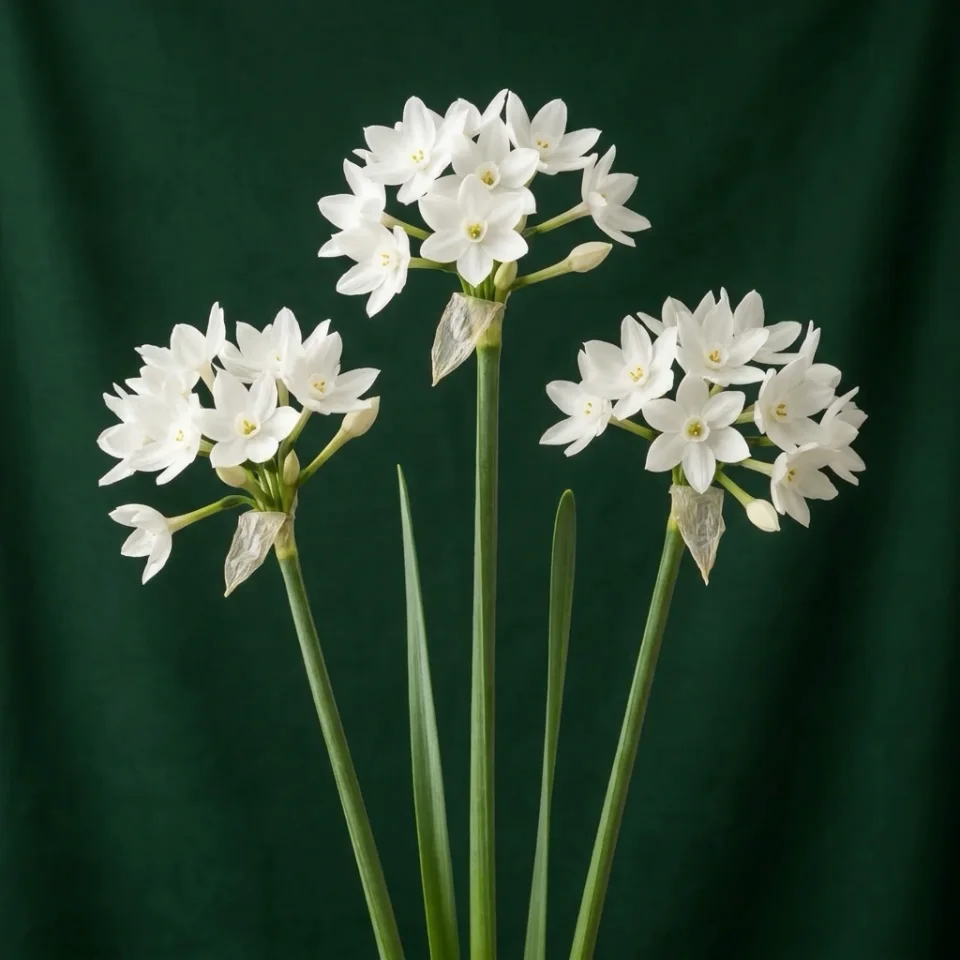
Botanical reference: Narcissus papyraceus Ker Gawl.
What paperwhite is
Paperwhite is Narcissus papyraceus, a narcissus with small, pure white flowers in clusters of up to ten per stem. Outdoors it flowers from late winter to early spring, but the bulbs are usually sold to bring into flower indoors in midwinter. You will also find it as Narcissus tazetta subsp. papyraceus or ‘Paper White’.
It is not the yellow trumpet daffodil sold in spring, which has its own page. Nor is it the Lunar New Year narcissus, Narcissus tazetta, with its yellow cup. The image on this page shows stems of small white star-shaped flowers in clusters, with a few buds.
A scent not everyone likes
Its scent is very strong and, in most varieties, musky. Some people love it and others find it unpleasant. Some varieties, such as ‘Ziva’, have a strong smell that some find objectionable; others, such as ‘Inbal’, smell less or more pleasantly.
Do not put it in a bedroom, a small office or on the table where you eat. It works better in a spacious hallway or a room you can air. Strong smells can cause nasal discomfort even without an allergy; the guide to scented flowers helps you find alternatives.
Forcing the bulbs in gravel and water
Choose a bowl without holes and put a 3–5 centimetre layer of washed gravel or stones in the bottom. Set the bulbs on top, pointed end up, and surround them with more stones, leaving the tips exposed. Add water until it touches the base of the bulbs, without covering them, and always keep it at that level.
Leave it somewhere cool, between 7 and 15 °C, for one to three weeks so it can root. When the shoots are about 7 or 8 centimetres tall, move it to a bright window at 15–21 °C. They usually flower four to six weeks after planting, so for flowers at Christmas plant them between mid and late November.
The stems can reach 45–50 centimetres and tend to flop. Give them a stake or try the alcohol trick: top up with a 4–6% solution, for example one part of a spirit of about 40% to seven parts water. The plants end up a third to a half shorter, with flowers of the same size and the same scent. Do not use beer or wine: their sugars encourage mould.
When they start to open, move them out of direct sun to a slightly cooler spot: the flowers will last longer.
Cut stems and mixed bouquets
Narcissi release a slimy substance from the cut that passes into the water and can shorten the life of other flowers in the vase. So before combining them with other flowers, they are stood on their own in a separate container for a few hours and that water is then thrown away. This advice is meant for narcissi in general; we have not found one specific to paperwhites, so apply it as a precaution.
If they are already in a mixed bouquet, it is best not to recut them: some florists warn that they release sap again. If you need to shorten them, give them a vase of their own.
Wear gloves when handling bulbs, stems and flowers: the sap irritates the skin and can cause contact dermatitis.
Children and pets
All parts of the narcissus are toxic because of their alkaloids, and the bulb is the most poisonous. Eating a significant amount can cause nausea, vomiting, diarrhoea and salivation and, in serious cases, tremors, convulsions, low blood pressure and heart rhythm problems. It is also toxic to dogs, cats and horses.
Put the bowl where small children and pets cannot reach it, and keep unplanted bulbs in their labelled bag, away from the kitchen. If someone has eaten part of the plant, call a poison information service; if it is an animal, call the vet. Keep the label or a photo to hand.
Guides to help with your decision
When to give daffodils
Daffodils as a gift: cut stems or a pot, mixing with other flowers and care after flowering. Leaves, watering, forced bulbs and precautions.
When to give amaryllis flowers
Giving amaryllis: choose cut Hippeastrum, a potted plant or a bulb, plan delivery and care for the flowers without promising a flowering date.
When to give hyacinths
Giving hyacinths: scent, a pot or cut stems, delivery and care after flowering. How to choose Hyacinthus orientalis and what to check around pets.
How to care for a bouquet when it arrives
Bouquet care on arrival: water, stem cutting, flower food and mixed flowers. What to check if it looks limp and how to keep the flowers still doing well.
Scented or low-fragrance flowers: how to choose
How to choose fragrant or low-scent flowers around the recipient and setting. What to ask about varieties, foliage and substitutions.

Which flowers to give to someone with cats or dogs
Flowers for a home with cats or dogs: options to consider, checking the whole bouquet and precautions with lilies, holly and mistletoe at Christmas.
Lunar New Year flowers: plants, bouquets and delivery
Lunar New Year 2027 falls on Saturday 6 February. Choose a plant or bouquet, decide how many lucky bamboo stalks to order and plan the delivery.
Frequently asked questions
Can I get rid of the paperwhite smell?
No. What you can do is choose a variety with a gentler scent and place it in a large, well-aired space, away from the bedroom and the table. If someone at home dislikes it, choose a different flower.
Can I force the bulbs again next year?
It is not recommended: bulbs forced in water cannot be forced again. Buy new bulbs each winter; in mild climates you can try planting the old ones in the garden, with no guarantee.
Sources and what they support
- Kew · Plants of the World Online · Narcissus papyraceus
Narcissus papyraceus Ker Gawl. is the accepted species of paperwhite narcissus (Amaryllidaceae). Does not identify the cultivar of bought bulbs or stems.
- RHS · Narcissus papyraceus
Clusters of up to 10 strongly scented, pure white flowers from late winter to early spring. Synonyms: Narcissus tazetta subsp. papyraceus and Narcissus 'Paper White'. Hardiness H4, hardy through most of the UK. Harmful if eaten and a skin irritant: wear gloves. A British profile; does not guarantee the hardiness of a freshly forced bulb.
- Iowa State University Extension · Forcing Paperwhite Narcissus Bulbs
Bowl without drainage holes, with washed gravel or stones; bulbs on top, surrounded by stones with the tips exposed; water up to the base of the bulbs, kept at that level. Cool (7–10 °C), dark spot for 2–3 weeks to root; with shoots of about 7–8 cm, move to a sunny window at 15–21 °C. Plants may reach 45–50 cm and need staking; moving them out of direct sun when they flower prolongs bloom. Most varieties have a musky scent; ‘Grand Soleil d’Or’ is sweet and fruity. Discard bulbs after flowering: they cannot be forced again and are not winter-hardy in Iowa. Reviewed November 2022.
- Illinois Extension · Good Growing · How to grow and care for paperwhites, 13/12/2024
Gravel at least 3–5 cm deep and water up to the base of the bulbs without submerging them. They typically bloom 4–6 weeks after planting; planting every 10 days gives flowers all winter. A week or two somewhere cool (10–15 °C) encourages rooting; slightly cooler temperatures prevent floppy stalks, and a cooler spot out of direct sun prolongs the flowers. According to Cornell research, a 4–6% alcohol solution reduces height by a third to a half, with the same flower size, fragrance and longevity (1 part spirit of about 40% to 7 parts water); not beer or wine because of the sugars. ‘Ziva’ has a strong, musky fragrance some people find objectionable; ‘Inbal’, ‘Wintersun’ and ‘Grand Soleil d’Or’ have less or a more pleasing scent. Illinois extension blog; does not cover toxicity.
- Iowa State University Extension · All About Daffodils
Daffodils exude a slimy substance from cut stems that passes into the water and harms other flowers; stand them in a separate container for a few hours, replace the water and then combine them, even re-cut if needed. Lists the non-hardy paperwhites forced indoors among the Tazettas, but the cut-flower advice does not mention them: applying it to paperwhites is our precaution.
- Society of American Florists · Daffodil
Daffodils secrete a sap that can harm other flowers if they are not first conditioned separately; once mixed with other flowers, do not recut them, as this releases sap again. US florists’ association; does not mention paperwhites and partly contradicts Iowa State on recutting.
- NC State Extension · Narcissus
Genus Narcissus: medium severity; toxic mainly if large amounts are eaten: nausea, vomiting, diarrhoea, salivation, trembling and convulsions, low blood pressure and arrhythmias; the bulb is the most poisonous part. Contact dermatitis from handling bulbs, flowers and stems. Alkaloids such as lycorine and calcium oxalate crystals. Genus profile; does not single out N. papyraceus.
- ASPCA · Narcissus
Narcissus spp., with ‘Paper White’ among its common names: toxic to dogs, cats and horses (lycorine and other alkaloids); vomiting, salivation and diarrhoea; large ingestions cause convulsions, low blood pressure, tremors and arrhythmias. The bulb is the most poisonous part. Not a substitute for veterinary advice.
- Visuotinė lietuvių enciklopedija · Narcizas
Lithuanian encyclopedia: skaistusis narcizas (Narcissus papyraceus) is listed, less often, among cultivated narcissi; all parts of narcissi are poisonous because of the alkaloids narcissine and lycorine. Gives no care advice or doses.
How we put these guides together
We review dates, care and recommendations to help you plan each gift.
Spotted something we should review? Contact Agenda Floral.