Flowers
Holly: choosing berried sprigs, buying it cultivated and keeping it away from children and pets
For Christmas decorations, buy cultivated holly from a nursery or florist that can tell you where it comes from: in many regions wild holly is protected and may not be cut. Keep it somewhere cool with the stems in water and place it out of reach of children and pets, because the berries are toxic if eaten.
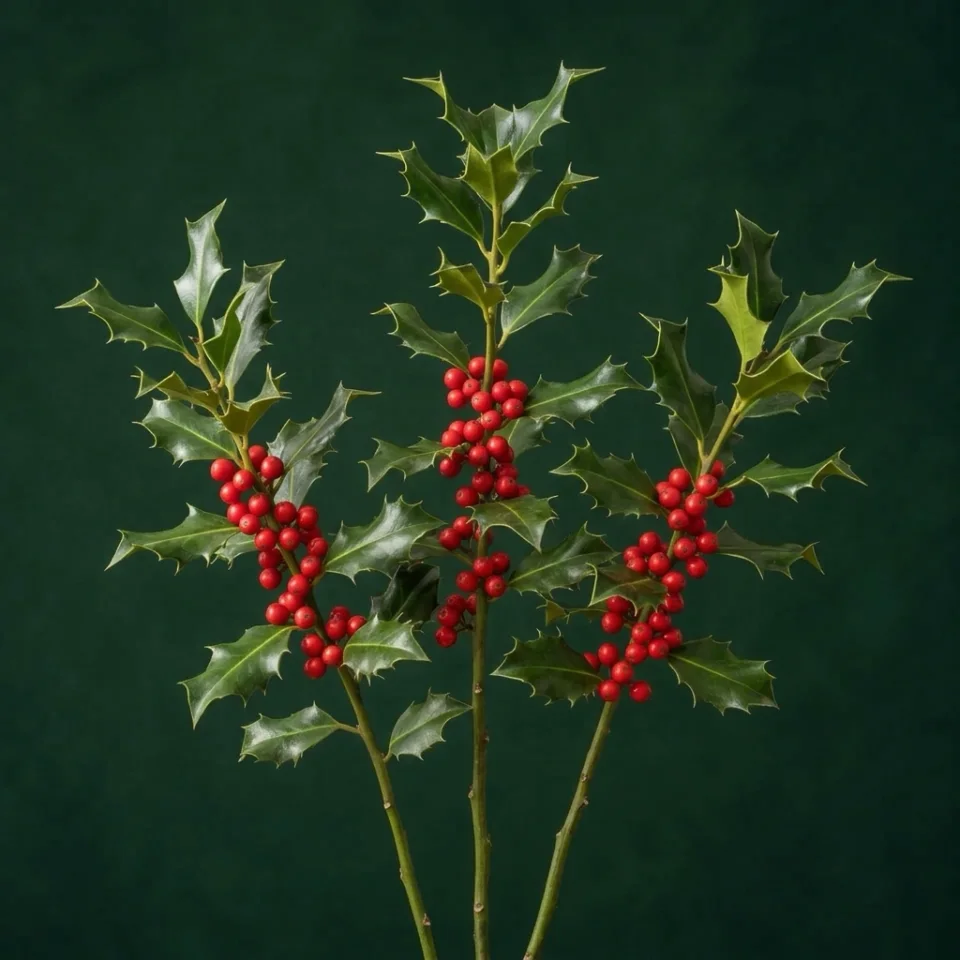
Botanical reference: Ilex aquifolium L.
Spiny leaves, and berries only on female plants
European holly, Ilex aquifolium, is an evergreen tree or shrub native to Europe, North Africa and western Asia. Its leaves are leathery and glossy dark green, and most have a wavy edge with spine-tipped teeth, although some are smooth and flat.
There are male and female plants. Only the females bear berries, and only if a male nearby pollinates them. That is why some sprigs arrive laden with red berries and others have none at all, even though they are the same species. The image on this page shows sprigs of spiny leaves with clusters of red berries.
Buy it cultivated: wild holly is protected in many places
In Spain, holly protection depends on each region. In Catalonia it is a protected species and collecting, cutting or uprooting it is forbidden; in December the Agents Rurals check shops, markets and fairs. In the Community of Madrid it may not be cut or uprooted either, and gathering it without permission can be fined up to 2,000 euros. In Asturias it is a species of special interest, and its use as a Christmas tree is listed among its threats.
Outside Spain the picture is similar. In mainland Portugal it is forbidden to uproot, cut, transport or sell wild holly. In Germany its wild populations are a specially protected species. In Italy each region has its own list: in Lazio, for example, wild holly may not be gathered or sold.
The simplest option is to buy it from a nursery or florist that can tell you where it comes from. If nobody can tell you the origin, choose different greenery. And if you have a holly in your garden, its branches are the easiest choice of all.
Keeping it fresh indoors
If you cut it yourself, wear gloves, as the leaves are prickly. Use clean, sharp secateurs and put the stems in water straight away. Before making a wreath or a centrepiece, leave it soaking in water overnight so it takes up plenty of moisture. Until you use it, keep it somewhere cool but frost-free: if cut holly freezes, the leaves and berries may turn black.
Keep it away from radiators, warm-air vents and windows in direct sun. A wreath hung outdoors lasts four or five weeks; indoors it looks fresh for one or two, depending on how warm the room is. If the wreath has moss, keep it moist.
Toxic berries: where to put it
Red berries catch small children’s eye. In France, poison centres receive between 60 and 80 calls a year about under-15s who have eaten holly, and around 40% of them come in December and January. One or two berries usually cause no symptoms or only mild digestive upset; more can cause heavy drooling, persistent vomiting and diarrhoea, drowsiness or convulsions. The tough, spiny leaves rarely cause poisoning.
Holly is also toxic to dogs and cats. The usual signs are vomiting, diarrhoea and lethargy, but if they eat a lot of berries it can affect the nervous system. Put berried sprigs up high, on the door or a shelf, rather than in a low centrepiece within easy reach. Pick up any fallen berries every day.
If a child has put leaves or berries in their mouth, wipe their mouth with a damp cloth, give them nothing to drink and call a poison information service. If it is an animal, call the vet. Keep the label or a photo of the plant to hand.
Wreaths, centrepieces and berry-free alternatives
In the UK, holly and ivy with berries are traditional materials for Christmas wreaths, together with spruce or pine. In France, its sprigs and leaves are often used to make wreaths. These are customs, not rules.
To order a door wreath you could ask for: “A wreath of about 35 centimetres with cultivated holly and ivy, to hang outdoors. Can you tell me which grower the holly comes from?”
If there are small children at home or a dog that chews everything, look for the same contrast without berries within reach: a skimmia with red buds, which are not berries, or a fir wreath with red ribbons.
Guides to help with your decision
Mistletoe: buying it, hanging it and keeping it away from children and pets
What Viscum album is, how to choose a sprig with berries for Christmas or New Year, how long it lasts and why to hang it high: leaves and berries are toxic if eaten.

Fir branches: choosing Nordmann fir, keeping it fresh and knowing when to stop using candles
How to recognise Abies nordmanniana branches, why they last longer than spruce, where they come from, how to keep them fresh in a wreath and when to switch to electric candles.
Santa Llúcia in Barcelona: moss, greenery and plants for the nativity scene
Santa Llúcia falls on Sunday 13 December 2026 and the Cathedral fair runs from 27/11 to 23/12. What greenery to buy, what not to collect and which plant to give.
Christmas in the UK: flowers for Christmas dinner
Christmas stays on 25 December even when the substitute bank holiday moves. Choose flowers for Christmas dinner and arrange an earlier delivery.
Christmas in Portugal · Natal and Consoada flowers
25 December and dinner on the 24th in Portugal: choose a poinsettia for the home or a table arrangement, with delivery suited to your plans.
Christmas in Italy: a poinsettia or flowers for the table
Natale 2026 falls on Friday the 25th and Santo Stefano on Saturday the 26th, both public holidays in Italy. Choose a poinsettia for the home or a table centrepiece and plan delivery for dinner on the 24th or lunch on the 25th.
Which flowers to give to someone with cats or dogs
Flowers for a home with cats or dogs: options to consider, checking the whole bouquet and precautions with lilies, holly and mistletoe at Christmas.

How to care for skimmia in a pot
Shade, watering, potting mix and pruning for Skimmia japonica. Tell reddish flower buds from berries and keep roots moist without waterlogging.
Frequently asked questions
Why doesn’t my holly sprig have any berries?
It probably comes from a male plant, or from a female with no male nearby to pollinate it. Only female plants bear berries, so a sprig without them is not lower quality: it works just as well in a wreath.
Can I gather holly from the wild?
In many places, no: wild holly is protected in Catalonia, the Community of Madrid, mainland Portugal and Germany, among other places. Buy cultivated holly or use some from your own garden.
Sources and what they support
- Kew · Plants of the World Online · Ilex aquifolium
Ilex aquifolium L. is the accepted species of European holly (Aquifoliaceae). Does not identify the cultivar or origin of a bought sprig.
- NC State Extension · Ilex aquifolium
Dioecious species: the female plant needs a male pollinator to bear reddish fruit. Leathery, glossy, dark green leaves with marginal spines. Native to Europe, North Africa and western Asia; the traditional Christmas holly in Europe. Low toxicity (saponins): vomiting, diarrhoea and depression, mainly in large amounts; fruit particularly poisonous to children. North Carolina plant profile.
- Gobierno del Principado de Asturias · Red Ambiental · Acebo (Ilex aquifolium)
Regional profile: a species of special interest in Asturias, with its own management plan (Decree 147/2001). Dioecious tree or shrub; leaves with large spiny teeth, sometimes entire and flat; bright red fruit. Its exploitation as a Christmas tree is listed among its threats. Asturias only; gives no bans or fines and is undated.
- Agents Rurals · Generalitat de Catalunya · Per un Nadal respectant el medi natural
In Catalonia it is forbidden to collect holly (Ilex aquifolium), a protected species. No plant may be collected in protected natural areas. The Agents Rurals inspect shops, markets and fairs and confiscate illegal material. Page updated on 02/12/2022; it does not cite the specific regulation.
- Comunidad de Madrid · Prohibición de recoger musgo, tejo o acebo en el campo (06/12/2019)
Holly is protected in the Community of Madrid: it may not be cut or uprooted, gathering it without authorisation can be fined up to 2,000 euros and, to use it, it must be bought from nurseries. 2019 press release; cites neither the regulation nor the scientific name.
- ICNF · Azevinho espontâneo
Decree-Law 423/89 prohibits uprooting, cutting wholly or partly, transporting and selling wild holly (Ilex aquifolium) throughout mainland Portugal. A voluntary accreditation scheme for growers has existed since 1990; a copy of the credential, with the details of each batch, accompanies the sales document to the final consumer. Gives no fines and does not regulate Madeira or the Azores.
- Bundesartenschutzverordnung (BArtSchV) · Anlage 1
In Germany, Ilex aquifolium (Stechpalme) is listed as a specially protected species (besonders geschützt), for wild populations only; domesticated forms are not covered. The list does not regulate cultivated sprigs or set penalties.
- Regione Lazio · L.R. 19 settembre 1974, n. 61 (flora spontanea protetta)
Lazio regional law. Art. 3 bans gathering or unjustified possession of wild holly (Ilex aquifolium). Art. 6 bans selling wild plants of protected species and requires cultivated ones to carry the grower’s certificate of origin. Lazio only; an informative 2015 copy without legal value, published by the regional parks agency.
- Clemson Cooperative Extension · Holiday Decorating With Fresh Greenery (HGIC 1753)
Cut with clean, sharp tools and put stems in water straight away; soak greenery overnight before arranging; keep it somewhere cool until use; do not let cut holly freeze, or leaves and berries may blacken; never near space heaters, heating vents or sunny windows. Holly berries are poisonous. South Carolina fact sheet, updated 2023; gives no lifespan for holly.
- RHS · Christmas wreaths
Holly and ivy with berries as traditional Christmas wreath materials, alongside spruce and pine; outdoors they last four or five weeks, indoors one or two depending on warmth; the moss must be kept moist. A British guide to making them, not a guarantee for a bought wreath.
- Anses · Plantes décoratives : leur ingestion peut être toxique pour les hommes comme pour les animaux (15/12/2020)
Holly sprigs and leaves are often used to make wreaths; the berries attract children. French poison centres receive 60 to 80 calls a year about under-15s, around 40% in December and January. One or two berries: no symptoms or mild digestive upset; more: heavy drooling, persistent vomiting and diarrhoea, drowsiness or convulsions. The leaves are rarely involved. In dogs and cats, digestive signs and, with many berries, neurological ones. First aid: wipe the mouth with a damp cloth, give nothing to drink and call a poison centre; for animals, a vet. French data.
- ASPCA · English Holly
Ilex aquifolium, toxic to dogs, cats and horses (saponins): vomiting, diarrhoea and depression; leaves and berries of low toxicity. Not a substitute for veterinary advice.
How we put these guides together
We review dates, care and recommendations to help you plan each gift.
Spotted something we should review? Contact Agenda Floral.