Guides
How to care for grey-leaved euryops in a pot
Care difficulty5 out of 10
Pay attention to growing conditions and watering.
Editorial guide, with suitable light and climate. 0: very easy; 10: very delicate. More stars mean more care.
Grey-leaved euryops needs direct sun, a pot that drains freely and watering guided by the rootball. It is an outdoor shrub rather than a plant to leave in the living room all year. Where frost occurs, prepare very bright shelter that stays frost-free. It can have a long flowering season, but climate matters and uninterrupted blooms are not guaranteed. Do not eat any part of the plant.
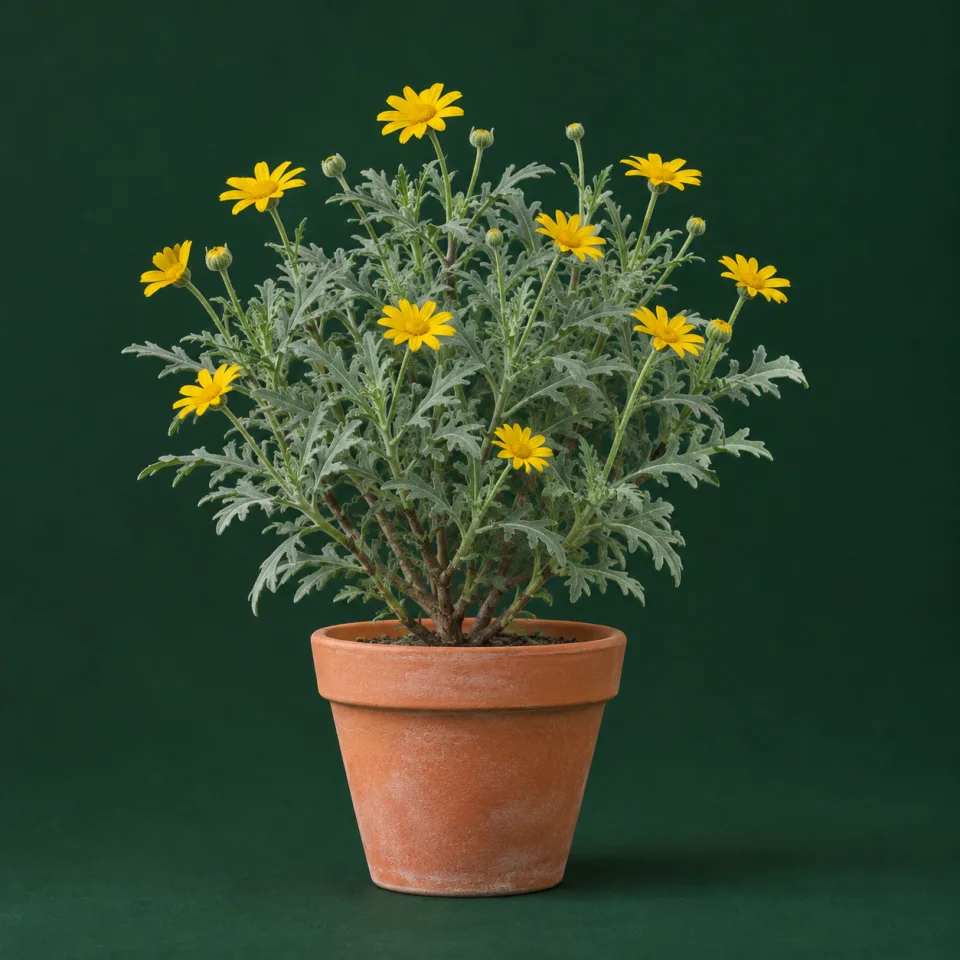
Botanical reference: Euryops pectinatus
Recognising the euryops you have
This guide covers Euryops pectinatus, with soft, lobed grey-green leaves and yellow flower heads held on slender stalks. Viridis has smoother green leaves. Euryops virgineus and plants sold as Gamolepis should not be identified from yellow flowers alone either. Keep the label. A small specimen can become a broad, woody shrub, so leave room for growth and for moving the pot.
Outdoor sun and a gradual adjustment
Choose a terrace with several hours of direct sunshine and shelter from strong wind. Deep shade usually means fewer flowers and elongated branches. Acclimatise a plant from a covered nursery gradually before placing it near a hot wall. Check the container too, as it can overheat. A room that looks bright to you may still provide too little light for this shrub.
Arrange winter shelter before frost arrives
It can stay outdoors in mild climates and sheltered positions, but that is no promise for every winter. The length of cold spells, wind and moisture matter; potted roots are more exposed than roots in the ground. When frost is forecast, find very bright, cool shelter that will not freeze. Avoid a dark garage and a heated living room. Reduce watering without allowing the rootball to dry out completely.
Choose a stable pot with drainage holes
Use a container with clear drainage holes and a stable base against wind. A closed decorative outer pot only works if you can remove the inner pot and empty any collected water. Increase size moderately: a large volume of damp compost around small roots dries slowly. Retain the previous planting depth and leave room below the rim for watering.
Compost that retains moisture without becoming compacted
Choose a container mix that keeps its structure and allows water through. A loam-based mix with coarse aerating material is easier to manage than compacted garden soil. You do not need an exact recipe. If water sits on the surface or the bottom stays saturated, check the holes and mix structure. Do not bury the base to hide bare branches.
Water the rootball rather than follow a fixed schedule
Feel below the surface and notice the pot’s weight. When the top layer dries and the mix below is no longer wet, water slowly to moisten the rootball, then let it drain. Check more often in heat or wind without watering automatically. Surviving dry periods in the ground does not make a pot self-sufficient. If water runs around the edges, apply it in several passes and check the centre.
Feed and repot when needed
During growth, fertiliser for flowering container plants can replenish nutrients. Follow its label and account for feed already in the mix; do not double doses to force flowers. Reduce or stop when growth stops. Repot in mild weather if roots fill the container or the compost loses structure. A newly bought plant that is stable does not need repotting simply as a routine.
Remove spent flowers and retain leafy growth when pruning
Remove dry flower heads and trim lightly after a main flowering flush, in mild weather that allows fresh growth. Avoid hard pruning before cold weather and retain healthy shoots. An ageing specimen can respond to renovation, but that does not guarantee recovery from damaged roots. If old branches dominate, work in stages instead of suddenly leaving a bare trunk.
Understand pauses in flowering
Sun helps flowering, but does not guarantee continuity. The season changes with climate and cultivation; months given for a South African garden or a greenhouse are not a universal calendar. During a pause, review light, recent cold, water and pruning before buying fertiliser. A shrub with firm leaves and new shoots may be growing without flowering. Watch its response when conditions improve.
Read symptoms before treating
Drooping leaves can accompany either dry or overly wet roots. Check the compost before adding water. Yellowing, a soft base or bad smell calls for a drainage and root check; after a cold night, consider temperature damage too. It does not need preventive insecticide. Inspect shoots and leaf undersides if you see stickiness, colonies or fine webbing. Identify the cause and temporarily separate the plant if you suspect pests.
Arrange watering while you are away
Before leaving, observe how the pot dries. Give its carer instructions based on moisture rather than a daily glass of water. Test any drip system and check that it moistens without saturating the bottom. A slightly more sheltered position can reduce wind-related demand for a few days. Do not shut it in darkness or leave the base submerged.
Place it safely and collect cuttings
Looking like a daisy does not make it edible. All parts are considered poisonous if eaten: do not put flowers on food or make leaf infusions. Prevent children or animals from chewing it and collect pruning debris. Wear gloves and wash your hands afterwards. Following ingestion, keep the label and contact a medical service, or a vet for an animal, without trying improvised remedies.
Guides to help with your decision
How to care for lavender in an outdoor pot
Sun, drainage, watering and pruning for potted Lavandula angustifolia, including winter care and warning signs.
How to care for a marguerite daisy in a pot
Sun, watering, spent flowers and frost protection: practical Argyranthemum frutescens care for a patio or terrace.
How to care for an African daisy in a pot
Sun, watering, flowering pauses and cold: practical care for an African daisy or osteospermum in a patio container.
Frequently asked questions
Can it live beside an indoor window?
That is not its usual position. It can spend cold weather in bright, cool shelter; a heated living room is no substitute for a terrace. Return it outdoors gradually when weather permits.
Is winter fleece enough to protect it?
It may help, but cannot guarantee the rootball will not freeze. With repeated frosts, prepare bright frost-free space and a container you can move before cold weather arrives.
Why are my euryops leaves completely green?
It may be Viridis or another plant with a similar common name. Check the label and foliage. Do not try to turn naturally green leaves silver with treatments.
Should I water when it droops in wet compost?
Not automatically. Check saturation, water inside the outer pot and blocked holes. Wilting with a wet rootball can indicate a root problem; more water will not correct the cause.
What if it has few flowers in winter?
Consider climate and light. A pause does not prove it is dying. Match water to growth and keep roots aerated; extra feed or saturated compost will not make it flower.
How long can it stay in the same pot?
It can be kept for several years in good conditions, without a guaranteed lifespan. Check roots, stability and compost structure; renew space or mix when needed, even while the plant is still flowering.
Sources and what they support
- RHS · Euryops pectinatus
Sun, drained compost, bright shelter and reduced winter watering without complete drying; light trimming and few usual problems. H3 describes UK conditions, not guaranteed pot hardiness.
- Kew · Euryops pectinatus, Species Profile
Accepted species, hairy grey foliage and possible renovation pruning. The profile states all parts are poisonous if ingested; it supplies no doses, symptoms or clinical prognosis.
- NC State Extension · Euryops pectinatus
Sun for flowering, moderate water and shelter from cold. Extended flowering in mild climates, not a universal year-round schedule. Viridis photographs in the profile do not define grey foliage.
- RHS · Container maintenance
General container principles for checking moisture, drainage, nutrients and repotting needs. These are not species-specific watering intervals or doses, nor a guarantee during absence.
- NParks · Euryops pectinatus ‘Viridis’
Distinguishes smooth green Viridis leaves from the species’ hairy grey foliage. Singapore pruning and flowering advice is not transferred to grey specimens or other winters.
- Kew · Gamolepis chrysanthemoides
Gamolepis chrysanthemoides is a synonym of Euryops chrysanthemoides, not E. pectinatus. This is a taxonomic reference, not care or safety guidance for grey-leaved euryops.
How we put these guides together
We review dates, care and recommendations to help you plan each gift.
Spotted something we should review? Contact Agenda Floral.