Guides
How to care for Brazilian jasmine in a pot
Care difficulty5 out of 10
Pay attention to growing conditions and watering.
Editorial guide, with suitable light and climate. 0: very easy; 10: very delicate. More stars mean more care.
Brazilian jasmine needs plenty of light, warmth and a moist mix that drains freely. On a very hot patio, morning sun and some afternoon shade are easier to manage than a scorching wall. If winters are cold, arrange a bright, moderately warm shelter before frost arrives. Leaving it unwatered until warm weather returns is not enough. Guide the stems if it climbs and wear gloves when cutting, as the sap can irritate skin.
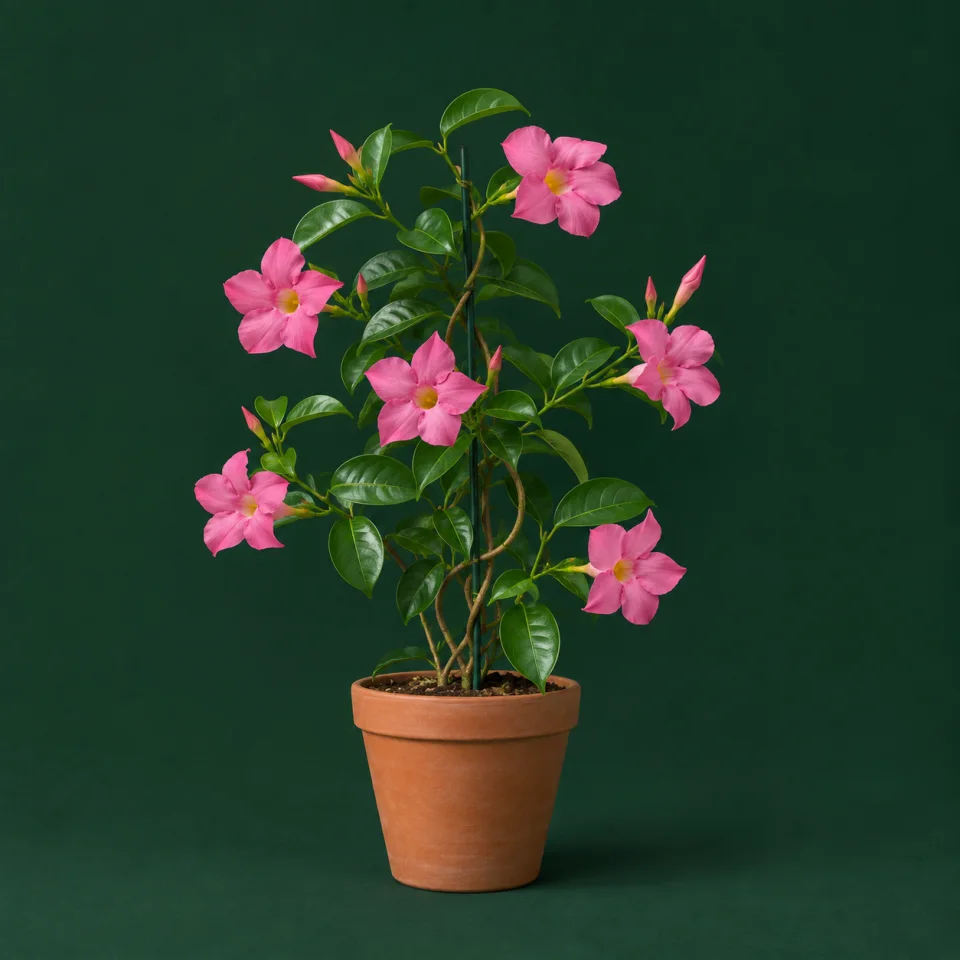
Botanical reference: Mandevilla sanderi
Know which dipladenia you have and how it will grow
Mandevilla sanderi is also known as Dipladenia sanderi or Brazilian jasmine. It is not a Jasminum and should not be given the same care as Mandevilla laxa, which can tolerate more cold. Many commercial dipladenias are hybrids or compact selections with different vigour. Keep the label to find out whether yours remains bushy or produces long stems. A small flowering plant may later need more space and support. Before choosing its position, check where you will shelter it over winter.
Strong light without a sudden move into fierce sun
Choose a warm, sheltered patio with sun or very bright light and some light shade during the hottest hours if needed. Deep shade can lengthen stems and reduce flowers. A plant raised under cover needs gradual acclimatisation outdoors. Avoid overheating the pot against a wall or exposing leaves to a dry blast of hot air. Leave enough space to inspect leaf undersides and water the mix without soaking the flowers.
A stable pot for roots and support
Choose a container with clear drainage holes, a little larger than the root ball and stable enough to carry the top growth. Use a structured potting mix with mineral components and good drainage rather than moving straight into an enormous pot. Keep the original planting depth and leave a watering rim. If a stake or trellis is needed, fit it without forcing it through roots. A support attached to the pot makes the whole plant easier to move under cover. Empty the saucer or outer pot after watering.
Water according to the root ball and weather
Check beneath the surface. As the upper layer starts to dry and the mix below is no longer wet, water slowly to moisten the root ball, then let it drain. During growth, neither complete drying nor saturation is helpful. In heat or wind, daily checks may be needed, without necessarily adding water each time. Before going away, test your watering arrangement or show your helper how to assess moisture. Water reserves in the roots do not make this a plant that can be forgotten during a holiday.
Feed and repot to support growth
During growth, apply fertiliser for flowering container plants according to its label, allowing for feed already in the mix. Use it on moist compost and reduce or stop when growth slows. Do not add extra to make up for cold or insufficient light. Repot when roots crowd the container or the mix has degraded, during mild growing conditions. Move to a slightly larger pot and preserve healthy roots. There is no need to repot a newly received flowering plant as a routine.
Guide stems and prune before renewed growth
Flowers form on the season’s new shoots. Attach climbing stems with loose ties and check that these do not cut in as stems thicken. Compact forms may need less training. Before strong growth resumes, remove dead or weak branches and shorten what is needed to keep a manageable framework. Pinching an occasional stem can encourage branching, but repeated clipping while flowering removes shoots that could bloom. Softwood cuttings are an option for propagation, but need controlled warmth and moisture; they are not a guaranteed rescue for a declining plant.
Winter protection still needs light
When nights turn cool, move the plant to a very bright, moderately warm, frost-free place before cold damages the leaves. Around 15 °C or above at night is a prudent reference when planning shelter. A dark garage that barely avoids freezing does not provide the same conditions. Water less, while retaining slight moisture in the root ball, and leave no standing water in the saucer. Leaf fall can signal cold or unsuitable conditions rather than harmless dormancy. Return it outside gradually when settled warm weather returns.
Check pests and avoid contact with sap
Inspect undersides and young shoots for mealybugs, whitefly, aphids or mites. Speckled, sticky or yellow leaves call for identifying the cause before treatment; check root moisture and temperature too. Wear gloves and eye protection when pruning, avoid touching your face and wash your hands afterwards. The white sap can irritate skin. Do not eat the plant or offer it as animal feed. Keep children and pets from chewing cut pieces. After ingestion, seek medical or poison-centre advice, or veterinary advice for an animal, with the plant label.
Guides to help with your decision
How to care for star jasmine in a pot
Light, water, support and cold protection for potted Trachelospermum jasminoides. Care for foliage and flowering without waterlogging.
How to care for pink jasmine in a pot
Jasminum polyanthum watering, light, pruning and shelter. Distinguish pink buds and white flowers from hardy yellow winter jasmine.
How to care for a bougainvillea in a pot
Sun, watering, support, pruning and cold protection for Bougainvillea glabra on a terrace. Protect its roots without forcing drought for colour.
Frequently asked questions
Why does it grow without flowering?
Check light, warmth and pruning first. Too much shade, cold nights or frequent clipping can limit new flowering shoots. Also review watering and the feed it already receives. Increasing fertiliser without fixing the position does not guarantee blooms.
Can I keep it outside all year?
Only if your climate and position maintain the warmth it needs. Even a frost-free winter can be too cold. Plan a bright, moderately warm shelter when nights cool, and adjust watering to growth. Do not use M. laxa’s cold tolerance to decide how to keep a commercial dipladenia.
Sources and what they support
- Kew · Mandevilla sanderi
Accepted tropical climber Mandevilla sanderi, with Dipladenia sanderi as synonym. Common names/photos do not identify commercial hybrids/cultivars or make it equivalent to Jasminum or M. laxa.
- NC State Extension · Mandevilla
Genus guide: commercial plants often hybrids, climbing or bushy habit, light and afternoon shade in heat, drained moisture, support/pinching and cold shelter. Mites, aphids, thrips and whitefly. Not a species profile or reason to assign all sizes/colours to M. sanderi.
- RHS · How to grow mandevillas
Group container care: light/warmth, outdoor acclimatisation, drained loam-based mix, slightly larger repot when crowded, labelled feeding, support and pruning before new growth. Bright temperate winter shelter, ideal nights around 15 °C or above, less water without complete drying. Irritating sap and gloves. No generalised UK calendar or M. laxa hardiness.
- Société Nationale d’Horticulture de France · Dipladenia ou mandevilla
Dipladenia genus/selections, airy container mix, strong light with heatwave relief, root reserves that do not remove watering needs, avoiding winter excess and possible mealybugs/mites/whitefly. Sap and hand/eye protection. Commercial parameters, months and propagation recipes are not universalised.
- Universität Zürich · Mandevilla sanderi / Dipladenia sanderi
Exact profile classifies M. sanderi as weakly poisonous. Describes latex irritants found in some Mandevilla spp. and no animal poisonings described in its cited literature; unsuitable as feed. Neither a safety guarantee nor invented clinical cases/severity; no ASPCA extrapolation from another species.
- RHS · Container maintenance
Checked container moisture/drainage, checks in heat/wind, feed already in the mix, repotting for root crowding/structure and watering plans during absence. General principles without guaranteed doses, dates or independence for this species.
How we put these guides together
We review dates, care and recommendations to help you plan each gift.
Spotted something we should review? Contact Agenda Floral.